
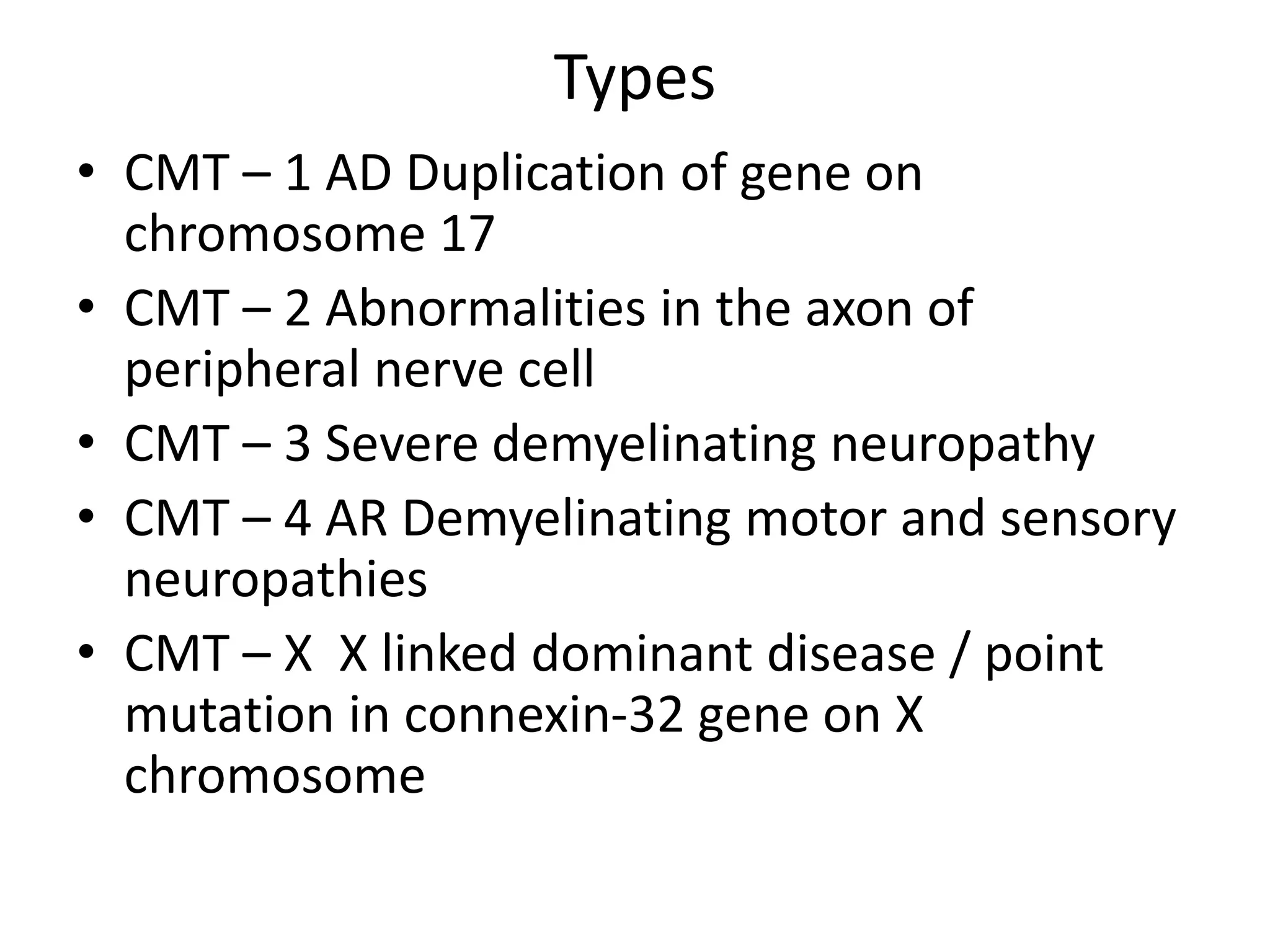
CMT – 1 AD Duplication of Gene on chromosome 17.
Hereditary motor and sensory neuropathy type I (HMSN I), also designated Charcot-Marie-Tooth disease type 1 (CMT1), is a peripheral neuropathy frequently inherited as an autosomal dominant trait, characterised by progressive distal muscular atrophy and sensory loss with markedly decreased nerve conduction velocity. A duplication within chromosome 17p11.2, cosegregating with the disease, has recently been reported in several CMT1a families. In order to estimate the frequency of this anomaly and determine the location of a duplication in this region, 12 CMT1 families were analysed with polymorphic DNA markers located within 17p11.2-12. Duplications were found in all families including loci D17S61 (EW401), D17S122 (VAW409R3a and RM11-GT), and D17S125 (VAW412R3). The duplications were completely linked and associated with the disease (lod score of 20.77 at zero recombination). Screening for the RM11-GT microsatellite showed that most of the duplicated haplotypes were heterozygous, supporting the hypothesis that the duplication resulted from an unequal crossing over. There was no significant haplotype association within the duplicated region suggesting that the duplication resulted de novo as an independent event in each family. In one family, recombination within the duplicated region was observed, indicating that genetic instability in 17p11.2 might be related to a high recombination rate. Since most cases of CMT1a seem to result from this segmental trisomy, it can be used as a basis for DNA diagnosis of the disease.
CMT – 2 Abnormalities in the axon of peripheral nerve cell
CMT2, also known as axonal Charcot-Marie-Tooth disease, is characterized by the degeneration of axons in the peripheral nerves. This degeneration leads to a variety of symptoms, including muscle weakness, atrophy, sensory loss, and foot deformities. The disease is caused by mutations in over 100 different genes, disrupting the function of nerve cells’ axons and their myelin sheaths. These disruptions result in impaired nerve signal transmission, leading to problems with muscle control and sensory feedback. The most common early sign of CMT2 is difficulty walking due to muscle weakness in the lower legs and feet, which can lead to distinctive foot deformities such as high arches and curled toes.
CMT – 3 Severe demyelinating neuropathy
CMT3, also known as Dejerine-Sottas disease or congenital hypomyelinating neuropathy, is a severe variant of Charcot-Marie-Tooth disease. It is characterized by early-onset symptoms such as hypotonia, delayed motor development, prominent sensory loss, distal followed by proximal weakness, absent reflexes, ataxia, and profound slowing of nerve conduction. The disease is caused by defects in genes for proteins found in axons and myelin, and it can be inherited in an autosomal dominant or recessive pattern.
CMT – 4 AR Demyelinating motor and sensory neuropathies
CMT type 4, also known as autosomal recessive demyelinating neuropathy, is a form of Charcot-Marie-Tooth disease characterized by a combination of demyelinating and axonal neuropathy. It is caused by mutations in genes that affect the structure and function of myelin sheaths, leading to the degeneration of nerve fibers. This type of CMT is inherited in an autosomal recessive manner, meaning that both copies of the gene must be mutated to cause the condition. Symptoms typically begin in the feet and legs and can progress to affect the hands and arms, leading to muscle weakness and sensory loss.
CMT – X X linked dominant decease / point mutation in connexin – 32 gene on X chromosome
CMTX, also known as X-linked Charcot-Marie-Tooth disease, is a genetic disorder that affects the peripheral nerves, leading to muscle weakness and atrophy, and changes in sensation, particularly in the feet, lower legs, hands, and forearms. It is caused by mutations in the GJB1 gene, which is located on the X chromosome. These mutations affect the protein connexin 32 (Cx32), which is crucial for the proper functioning of gap junctions in the peripheral nervous system. The condition is more severe in males due to the hemizygousity of the X chromosome. The progression of CMTX is generally slow, and individuals may lose ambulation function later in life. Research is ongoing to explore the effects of gene defects related to the peripheral nervous system and develop strategies to combat these effects.
Resources
- CMT – 1 AD Duplication of Gene on chromosome 17.
https://pmc.ncbi.nlm.nih.gov/articles/PMC1016177
- CMT – 2 Abnormalities in the axon of peripheral nerve cell
https://www.bing.com/search?q=cmt+2+abnormalities+in+the+axon+of+peripheral+nerve+cell&FORM=HDRSC1
- CMT – 3 Severe demyelinating neuropathy
https://www.bing.com/search?PC=F959&FORM=F959DF&q=CMT+%E2%80%93+3+Severe+demyelinating+neuropathy
- CMT – 4 AR Demyelinating motor and sensory neuropathies
- CMT – X X linked dominant decease / point mutation in connexin – 32 gene on X chromosome