
By Kathy Wechsler
In Quest Media (updated by Joanna Buoniconti), Wednesday, July 19, 2023 Muscular Dystrophy Association
5 SECOND SUMMARY
Do you want
to get the health benefits of standing without sacrificing mobility? Then here’s
what you need to know about features, pricing, and funding for mobile standers and
standing wheelchairs.
Mobile standers
and standing wheelchairs are for people who want to stand without having to stand
still.
Medical professionals agree that standing is good for the musculoskeletal system, and most experts recommend standing 30 to 60 minutes a day, depending on the user’s level of tolerance. (Note: Always consult a doctor before starting a standing program.)
There are also many psychological benefits of standing. “One of the biggest benefits is that it can increase independence and allow the individual to be an active participant in their daily routines,” Kelly says.
But reaping the physical and psychological benefits of standing can come at a price — loss of mobility. Mobile standers and standing wheelchairs get around this problem by offering users access to their environment.
Mobile standers
Similar in appearance to the average stationary stander, mobile standers have wheels and can be driven indoors while in use. They are either manually propelled by users with the arm strength to propel a manual wheelchair, or they are power-driven.
Two companies offer manual-drive mobile standers for adults: Altimate Medical and Prime Engineering […].
The standers are moved by pushing on the wheel push rims located at arm level. They come with either a manual hydraulic lift system or a power lift system to raise users from sitting to standing.
Some models require users to transfer into the device’s seat before standing, while other models allow individuals to roll up in their wheelchairs, line up their knees with the kneepads, put the lift sling under their bottom, attach it to the lift, and stand up.
Manual or power?
One manually propelled mobile stander is the EasyStand Evolv Mobile from Altimate Medical. The push rims are close to the user for easy steering, and they can be moved forward to allow more room for transfers. The Evolv Mobile retails for around $6,000.
Of course, many people with neuromuscular diseases have limited
arm strength and may have difficulty self-propelling a manual stander.
Stand Aid of Iowa is the only company that offers a power -driven adult
stander. The Stand Aid 1503 has a joystick -controlled power drive system and a power lift system, and it doesn’t require transferring from the wheelchair into the device before standing. It retails for $9,500, or mechanically inclined individuals can purchase the mobile kit to add on to their existing Stand Aid 1501 for $3,200.
Using a stander
There are many benefits to allowing a person to get out of their wheelchair to stand and stretch their muscles. The key is not to overdo it, as Jose Flores learned. Jose, a corporate speaker who has spinal muscular atrophy (SMA), uses the EasyStand Strapstand for 30 to 45 minutes twice a week during physical therapy to stretch out his arms and legs and prevent the onset of muscle contractures.
Jose has been going to physical therapy and using the stander for more than a year. Before that, his wife and sons used to stretch his arms and legs.
“The first time I used the stander, it was the first time that I had stood in 23 years, and it felt amazing. When I sat down, I noticed that my muscles and my knees were a little sore, but it only lasted for 5 to 10 minutes,” Jose says. “Now, when I stand, I don’t notice any discomfort at all.”
While standing, he likes to stretch his arms up and out. If he is short on time, he will put his phone or laptop on the built-in tray and answer emails while standing.
Standing wheelchairs
Why be limited to standing or sitting when you can do both?
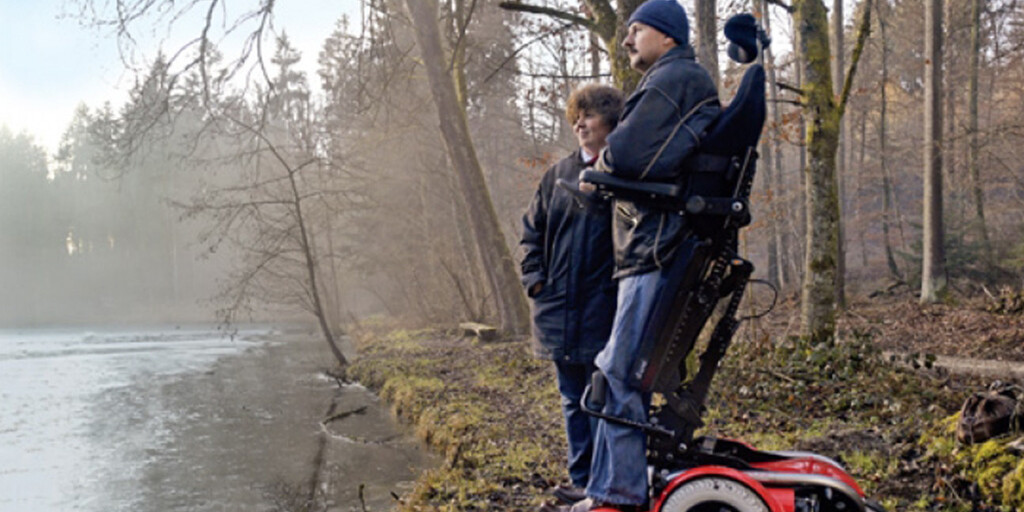
Standing wheelchairs offer the ability to rise into a standing position when needed and then return to a seated position at any time.
Standing wheelchairs also make it easier to get in more standing time while going about your regular day.
Power or manual?
As with mobile standers, standing wheelchairs come in two forms: power and manual.
Most can hoist users upright to a maximum of 85 degrees. Standing upright at a full 90 degrees (as can be done in a mobile stander) would throw the wheelchair off balance, although there are some power wheelchairs that stand users up to 87 degrees.
Most power standing wheelchairs can be driven while users are standing, whereas manual standing wheelchairs must remain stationary when in the standing position. However, those who like to travel may prefer the greater portability of a manual standing wheelchair.
The Levo LAE is a lightweight (37 pounds) manual standing wheelchair with a folding backrest and quick-release rear wheels for easy transport. The LAE lifts via a gas-powered spring and allows users to lift themselves into any angle between sitting and standing with one-handed operation. It retails for $4,800 to $19,000.
Permobil’s F5 Corpus VS and the M Corpus VS offer the ability for the individual to stand at various degrees. The F5 Corpus VS can achieve up to 80 degrees of standing, while the M Corpus VS can achieve up to 70 degrees of standing. These power standing wheelchairs can remember a user’s favorite standing position, whether it is sit-to-stand, recline-to-stand,
or anywhere in between. Fully drivable while standing, the F5 Corpus VS and the M Corpus VS have advanced suspension systems for a smooth ride. […]
Arm strength required | Choice of manual | Can be driven while | Can be used as a | Easily transported | Can be used outdoors | Price | |
Manual mobile stander | Yes | Yes | Yes | No | No | No | $3,200-$9,000 |
Manual standing | Yes | Yes | No | Yes | Yes | Yes | $7,000-$19,000 |
Power mobile stander | No | Power lift only | Yes | No | No | No | $9,500 |
Power standing wheelchair | No | Yes | Yes | Yes | Yes, with a lift-equipped | Yes | $9,900-$60,000 |
Article
available at: https://mdaquest.org/stand-and-go-mobile-standers-and-standing-wheelchairs/