
Building a Community of Support
By: Stephanie & Jon Betts

Our son, Henry James, came into the world at 37 weeks, just under 6 pounds, with a distinctly weak, chirping cry. To this day, he is still our “baby bird.”

As parents of two, we were familiar with the joy and anxiety that come with having a new baby. While those new parent concerns were calmed by our experience with Henry’s sisters, we also noticed some differences very early on.
Tummy time was a battle that Henry never won. Rather than lifting his head up, he would cry himself to sleep. He would take ages with a bottle, often growing too tired to even finish. When we picked Henry up under his armpits, it felt like he was going to slide right through our hands.
At a 3-month checkup, it became clear that this was more than Henry just progressing on his own time. Our pediatrician gave us the option to pursue testing immediately or wait, and we didn’t hesitate to proceed with testing right away. We wanted to know what Henry was dealing with so he didn’t have to continue struggling on his own.
Henry’s neurologist tested his blood for high protein, a symptom of muscular dystrophy. Results showed that Henry had a protein level of over 90 times the typical amount. It was devastating to hear, but also also a relief. Over the next few weeks, Henry’s diagnosis became Congenital Merosin-Deficient Muscular Dystrophy. We were still fearful, but grateful to know what we were dealing with and began building a support system.
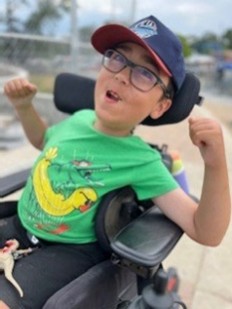
Since that diagnosis, Henry’s health journey has been punctuated by challenges big and small. He’s had multiple hospitalizations for pneumonia, broken bones, and surgeries to lengthen his hamstring muscles, set his femurs and rebuild his hip joints. He’s had sleep and swallow studies, breathing treatments and cough assist machines. But he’s also had overwhelming support from his medical team. Henry is genuinely excited to see the specialists he works with, and they hold a special place in our hearts too.
Despite his health challenges, Henry makes friends easily and his wheelchair and physical limitations have never been an issue with his peers. Henry’s big sisters, Grace and Claire, are loving and helpful even when he is being annoying in a way only the youngest child can. We are extremely fortunate to be surrounded by a community that cares for Henry and us.
This community includes the Muscular Dystrophy Association (MDA) and their running group, Team Momentum. They’ve been there as we’ve moved to a more accessible home, purchased a ramp-equipped van and navigated the challenges of travel with a power wheelchair. We lean on this group often, and we simply couldn’t do it without them.
Parenting, especially if you have a child with a disability, is filled with wondering, “Am I handling this properly?” One of the biggest challenges we’ve found is extending grace towards ourselves and finding time for self-care. This is essential for us to be fully present for our children and is a process we work towards each day.
To families who find themselves on the path we started over 10 years ago, we have simple advice: First, build your community. Accept support and ask for help. Second, know that you can never advocate too strongly for your child. You are their voice. Be proactive and speak up for what they deserve. Remember, you are not alone.
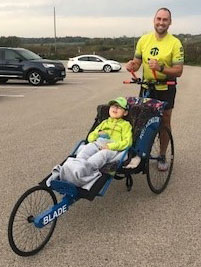
Henry James Betts is pictured above with his family, in his power chair, and with his dad, preparing to run a marathon. The Betts family would like to extend their gratitude towards the medical specialists, school staff, aides, family, friends and so many others who make up their loving community of support.
How do I know if my child has muscular dystrophy?
In addition to muscle weakness and delay in motor skills, children with muscular dystrophy often have high levels of creatine kinase (CK). CK is a muscle enzyme, which can be detected with a blood test.
Genetic testing is often able to confirm the diagnosis of muscular dystrophy. However, additional testing, such as electrical tests of the nerves and muscles (EMG and nerve conduction studies), muscle MRI and muscle biopsy may be necessary for some children.
What other challenges can people with muscular dystrophy have?
Respiratory muscle weakness:
Muscles of the chest wall and the diaphragm are important breathing muscles and can become weak. This also causes the chest wall to become stiff, which can further worsen breathing function. Some individuals with muscular dystrophy need breathing support or ventilators only when sleeping, while others need it continuously. In addition, they can have a weak cough, making it harder for them to clear mucus. Their pulmonologist (lung specialist) may recommend additional treatments and devices to help them cough more effectively.
Heart muscle or heart rhythm abnormalities:
Cardiomyopathy, or abnormal pumping and function of the heart muscle, occurs in certain types of muscular dystrophy and can lead to heart failure. Abnormal heart rhythms (arrhythmias) can also occur.
Scoliosis and contractures:
Individuals with muscular dystrophy can develop joint deformities called contractures, in which the joint becomes stiff or fixed. They may also have progressive curving (scoliosis) or rigidity in their spine. Contractures and scoliosis impair their mobility further and scoliosis can contribute to breathing difficulties.
Swallowing and speech problems:
The muscles used for swallowing and speaking can also become weak. Some children may need a feeding tube or adaptive communication devices.
Learning and social challenges:
Some children with muscular dystrophy have learning differences, autism, attention deficit hyperactivity disorder or developmental delays outside of those from muscle weakness. These children may benefit from having special education or other educational support services to optimize their learning.
Are there treatments available for muscular dystrophy?
All children with muscular dystrophy should have a multi-disciplinary care team. This team should include rehabilitation medicine specialists (for physical, occupational and speech therapies), neurologists, pediatricians and often pulmonologists, cardiologists, orthopedics, dietitian and gastroenterologists. School support services are also key.
The first gene therapy treatment for DMD has been approved by the U.S. Food & Drug Administration. This treatment is given as a single intravenous (through a vein) dose and was approved after clinical trials.
For DMD, there are additional treatments that slow progression of the disease. Steroids delay the loss of the ability to walk. Steroid medications may also help preserve arm strength and respiratory muscle strength, even for people dependent on wheelchairs. For certain types of DMD, there are additional treatments called “exon-skipping” medications which can help increase the amount of dystrophin protein in the muscle.
Steroids are sometimes used in other types of limb girdle muscular dystrophy. There are some medications that can be helpful for muscle and non-muscle symptoms seen in myotonic dystrophy.
There is lots of active research into therapies for muscular dystrophies, and there may be additional muscular dystrophy treatments available in the future.
Resources: