
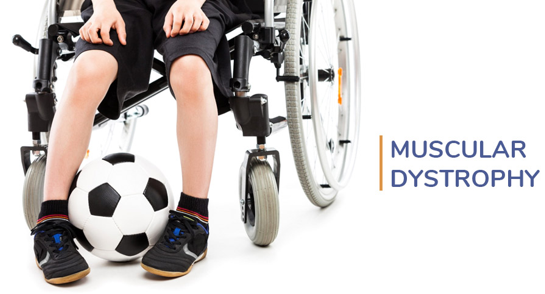
Muscular dystrophy is not just one condition. It is a group of genetic disorders that cause progressive muscle weakness and loss of muscle function.
For people living with muscular dystrophy, and for their families, understanding the condition can be an important first step towards finding the right support, medical care and resources.
There are many different types of muscular dystrophy. Each type can affect people differently, with differences in the age symptoms begin, the muscles affected, how quickly the condition progresses and whether other parts of the body, such as the heart or lungs, are affected.
Duchenne Muscular Dystrophy (DMD)
Duchenne muscular dystrophy is one of the most well-known forms of muscular dystrophy. It primarily affects boys and usually becomes noticeable in early childhood.
Children may experience difficulty running, climbing stairs, jumping or getting up from the floor. Muscle weakness gradually progresses and can affect mobility, breathing and the heart.
Duchenne is caused by changes in the DMD gene, which affects the production of dystrophin, an important protein that helps protect muscle fibres.
Becker Muscular Dystrophy (BMD)
Becker muscular dystrophy is also associated with changes in the DMD gene. It is similar to Duchenne muscular dystrophy but generally progresses more slowly.
Symptoms can begin in childhood, adolescence or adulthood, and the severity can vary considerably from one person to another.
Heart involvement can also occur, making appropriate medical monitoring important.
Facioscapulohumeral Muscular Dystrophy (FSHD)
Facioscapulohumeral muscular dystrophy, commonly known as FSHD, gets its name from the areas of the body it often affects:
- Facio – the face
- Scapulo – the shoulder blades
- Humeral – the upper arms
People with FSHD may have difficulty closing their eyes tightly, smiling or whistling, lifting their arms or raising objects overhead.
FSHD can begin in childhood or adulthood, and the severity can differ greatly between individuals. Some people experience relatively mild weakness, while others develop significant physical disability.
Limb-Girdle Muscular Dystrophies (LGMD)
Limb-girdle muscular dystrophy is actually a large group of different genetic muscular dystrophies.
Weakness commonly affects the muscles around the hips, thighs, shoulders and upper arms. People may have difficulty climbing stairs, getting up from a chair or lifting their arms.
There are many different genetic forms of LGMD, and their symptoms and progression can vary significantly.
Some forms can also affect the heart and breathing muscles.
Myotonic Dystrophy
Myotonic dystrophy is another important type of muscular dystrophy. It can affect both men and women and often begins during adolescence or adulthood, although it can occur at other ages.
One of its characteristic features is myotonia, meaning that muscles may have difficulty relaxing after they have been contracted.
Myotonic dystrophy can affect more than skeletal muscles. Depending on the type and individual, it can also affect the heart, breathing, swallowing, eyes and other parts of the body.
There are two main forms: Myotonic Dystrophy Type 1 (DM1) and Myotonic Dystrophy Type 2 (DM2).
Congenital Muscular Dystrophies
Congenital muscular dystrophies generally become apparent at birth or during infancy.
Children may have low muscle tone, muscle weakness or delayed motor development. Some forms can also affect the brain, eyes or other organs.
There are several different congenital muscular dystrophies, and their severity varies considerably.
Emery-Dreifuss Muscular Dystrophy
Emery-Dreifuss muscular dystrophy can cause muscle weakness and contractures, where joints become increasingly difficult to move because muscles and surrounding tissues become shortened or stiff.
It commonly affects the muscles around the upper arms, lower legs and neck.
Heart problems, particularly abnormal heart rhythms, can be an important feature of this condition.
Oculopharyngeal Muscular Dystrophy (OPMD)
Oculopharyngeal muscular dystrophy generally begins in adulthood.
The name describes two of its characteristic features:
- Oculo – affecting the eyes, particularly causing drooping eyelids
- Pharyngeal – affecting the muscles involved in swallowing
People may experience drooping eyelids and increasing difficulty swallowing food or liquids.
Distal Muscular Dystrophies
Distal muscular dystrophies are a group of conditions in which weakness often begins in the muscles furthest from the centre of the body, such as those in the hands, forearms, feet or lower legs.
There are several different genetic forms, and they can vary in their age of onset and progression.
Bethlem and Ullrich Muscular Dystrophies
Bethlem muscular dystrophy and Ullrich congenital muscular dystrophy are part of a group of conditions associated with abnormalities involving collagen VI, a protein important for muscle and connective tissue.
Bethlem muscular dystrophy often has a slower progression, while Ullrich congenital muscular dystrophy can cause significant weakness from infancy and may be associated with respiratory problems.
Why Awareness Matters
Although these conditions are different, people living with muscular dystrophy and their families often face many challenges.
These can include difficulties with mobility, education, employment, independence, access to appropriate healthcare and everyday activities. Families may also need emotional support, information and assistance in understanding the condition.
Awareness matters because understanding leads to compassion, support and inclusion.
A person with muscular dystrophy may look perfectly healthy while facing significant challenges that are not immediately visible. A little understanding can make a meaningful difference.
Every Person’s Journey Is Different
One of the most important things to remember is that muscular dystrophy does not affect everyone in the same way.
Two people with the same diagnosis may have very different symptoms, abilities and progression. Even within the same family, the experience can be different.
That is why care and support should be individualised and involve appropriate healthcare professionals.
There Is Hope in Research
Researchers around the world continue to study the genetic causes and mechanisms behind muscular dystrophies. Advances in genetic testing, disease management and emerging therapies are providing new knowledge and possibilities.
While there is still much to learn, ongoing research offers hope for improved treatments and better quality of life for people living with muscular dystrophy.
You Are Not Alone
A muscular dystrophy diagnosis can bring uncertainty, questions and fear. But people living with muscular dystrophy and their families do not have to face the journey alone.
The Muscular Dystrophy Foundation of South Africa (MDFSA) is committed to raising awareness, providing support and helping people affected by muscular dystrophy and their families connect with information and resources.
During International Muscular Dystrophy Awareness Month, we encourage everyone to learn more, talk about muscular dystrophy and help create communities where people living with these conditions are understood, supported and included.
Behind every diagnosis is a person.
Behind every person is a family.
And behind every family is a story that deserves to be heard.
Together, let’s raise awareness. Together, let’s show support. Together, let’s make a difference.